
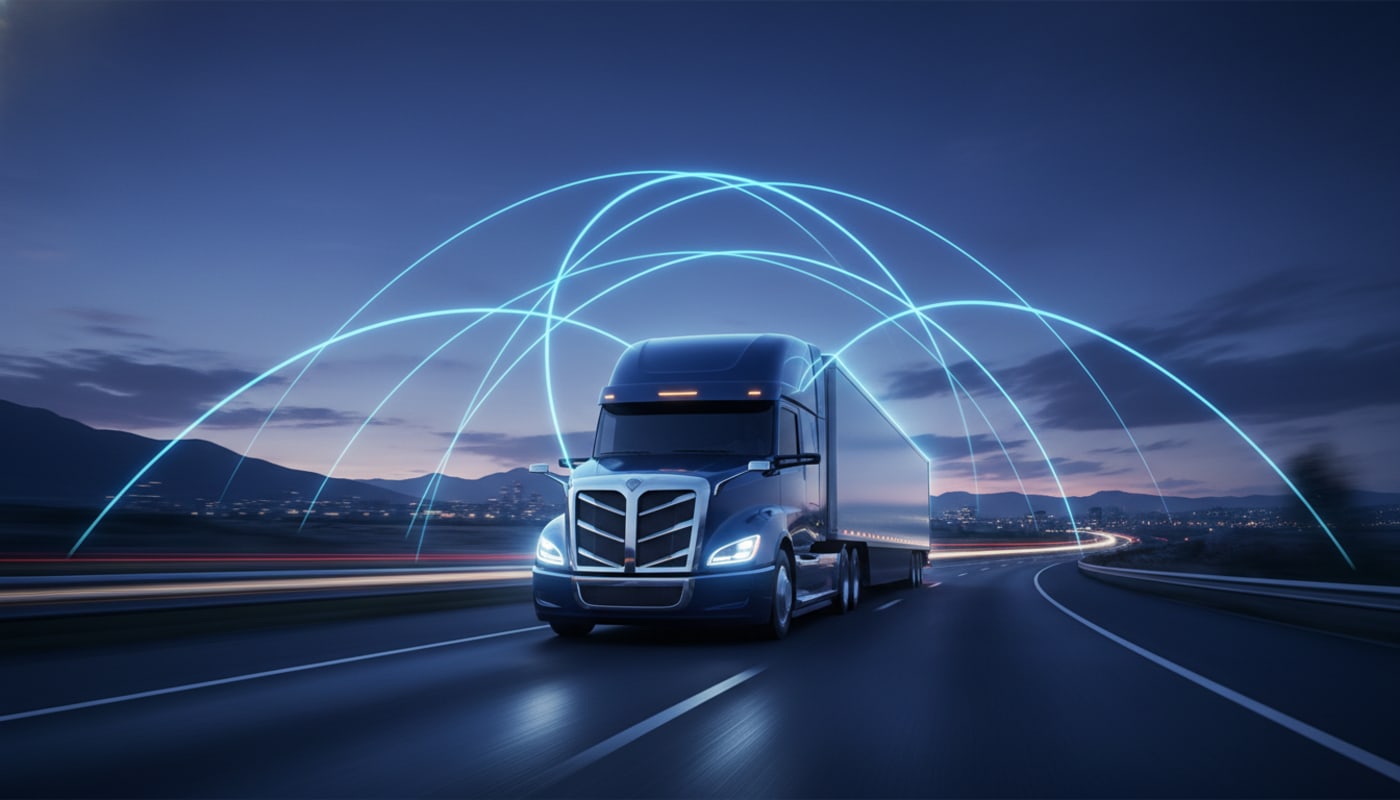
The commercial logistics industry has invested heavily in passive vehicle safety for decades. Crumple zones, lane departure warnings, automatic emergency braking — each generation of passive technology has made individual vehicles safer in isolation. But the rate of serious commercial vehicle incidents has not fallen at the pace this investment would suggest. The reason is structural: passive safety systems protect against collisions that are already happening. They cannot prevent the situations that cause collisions to begin in the first place.
The Limits of Passive Safety
Passive safety is retrospective by design. A collision mitigation system activates when sensors detect an imminent impact. It has no information about the vehicle three positions ahead that stopped suddenly two seconds ago. It cannot know that an emergency vehicle is approaching from a side road with no line of sight. It has no awareness of the road surface conditions reported by the truck that passed this stretch of highway forty minutes earlier.
This information exists — distributed across hundreds of vehicles and infrastructure nodes on and around the same route. The problem is that no mechanism currently aggregates and shares it in a form that reaches the driver in time to matter.
That is precisely the gap that connected safety intelligence is designed to fill.
What Connected Safety Changes
A vehicle equipped with V2X connectivity can receive safety-relevant information from sources it cannot see: vehicles over the horizon, infrastructure nodes at intersections, road condition data aggregated from recent traffic. The driver receives an advisory — not an automated intervention — before the hazard is visible. The additional seconds this provides are the difference between a controlled response and an emergency braking event.
For fleet operators, the aggregate effect is significant. Fewer hard braking events means less vehicle wear. Fewer incidents means lower insurance liability. Better driver awareness of high-risk corridors enables smarter route and timing decisions. The ROI case for connected fleet safety does not require dramatic reductions in major incidents to make commercial sense — the cumulative effect of reduced minor events and near-misses adds up across a large fleet at scale.
The Three Layers of Modern Fleet Safety
Thinking about fleet safety as a layered system is more useful than treating each technology as a standalone solution:
- Layer 1: Vehicle hardening. Structural safety, airbags, crumple zones. This layer is mature and well-regulated. It limits injury when a collision occurs.
- Layer 2: Driver assistance. AEB, lane departure, blind spot monitoring. This layer is active but reactive — it responds to hazards that sensors can directly detect. It has improved significantly and continues to do so.
- Layer 3: Network intelligence. V2X, V2V, connected hazard awareness. This layer is proactive — it extends the driver's awareness beyond the physical limits of what sensors can observe, and does so before the hazard enters the detection range of Layer 2 systems.
The industry has invested heavily in Layers 1 and 2. Layer 3 is where the next material reduction in fleet incidents will come from, and where investment is currently underweight relative to the opportunity.
The Fleet Operator's Perspective
Fleet safety managers face a practical challenge: their drivers spend most of their working hours in conditions where the primary risk factors are information-related, not vehicle-capability-related. A driver in a heavy goods vehicle on a night run between distribution centres is not usually undone by inadequate braking performance. They are undone by not knowing about the stopped vehicle around a bend, or the debris that fell from a flatbed thirty minutes ago, or the black ice patch that three vehicles before them managed to navigate but did not report.
Connected safety directly addresses this. A V2X-equipped fleet where vehicles share road intelligence creates a self-improving safety network — each vehicle's experience becomes immediately useful to every other vehicle on the same route. The safety dividend compounds with fleet size in a way that no passive technology can replicate.
Regulatory Trajectory
Regulation is catching up to technology in this space. The EU's ETSI and the European Commission's C-ITS Corridor programme have been building the standards and infrastructure frameworks for V2X deployment across European road networks. India's NHAI and Ministry of Road Transport have begun examining connected mobility standards as part of broader smart highway initiatives. The US Federal Highway Administration continues to fund V2X pilot programmes.
Fleet operators who begin integrating connected safety technology now — even in pilot form — will be substantially better positioned when regulatory mandates arrive. Those who wait for mandates to force adoption will find themselves compressing a technology transition into a much shorter window, at higher cost and with less operational experience to draw on.
What This Means for Logistics
The commercial logistics sector has a particular incentive to move early on fleet safety connectivity. Insurance markets are pricing commercial vehicle risk more precisely than ever, and operators with demonstrably lower incident rates — supported by data from connected systems — have access to pricing advantages that operators relying solely on passive safety records cannot match.
Beyond insurance, the sustainability agenda is pushing logistics operators toward tighter route optimisation and fewer wasted kilometres. Connected safety data provides exactly the kind of granular, real-time network intelligence that enables this — hazard-aware routing, time-of-day risk profiling for specific corridors, and the kind of aggregate operational insight that turns a fleet's collective experience into a competitive asset.
Passive safety protected the vehicle. Connected safety protects the operation. For modern commercial logistics, the distinction matters more than ever.
More from Insights
View all articles