
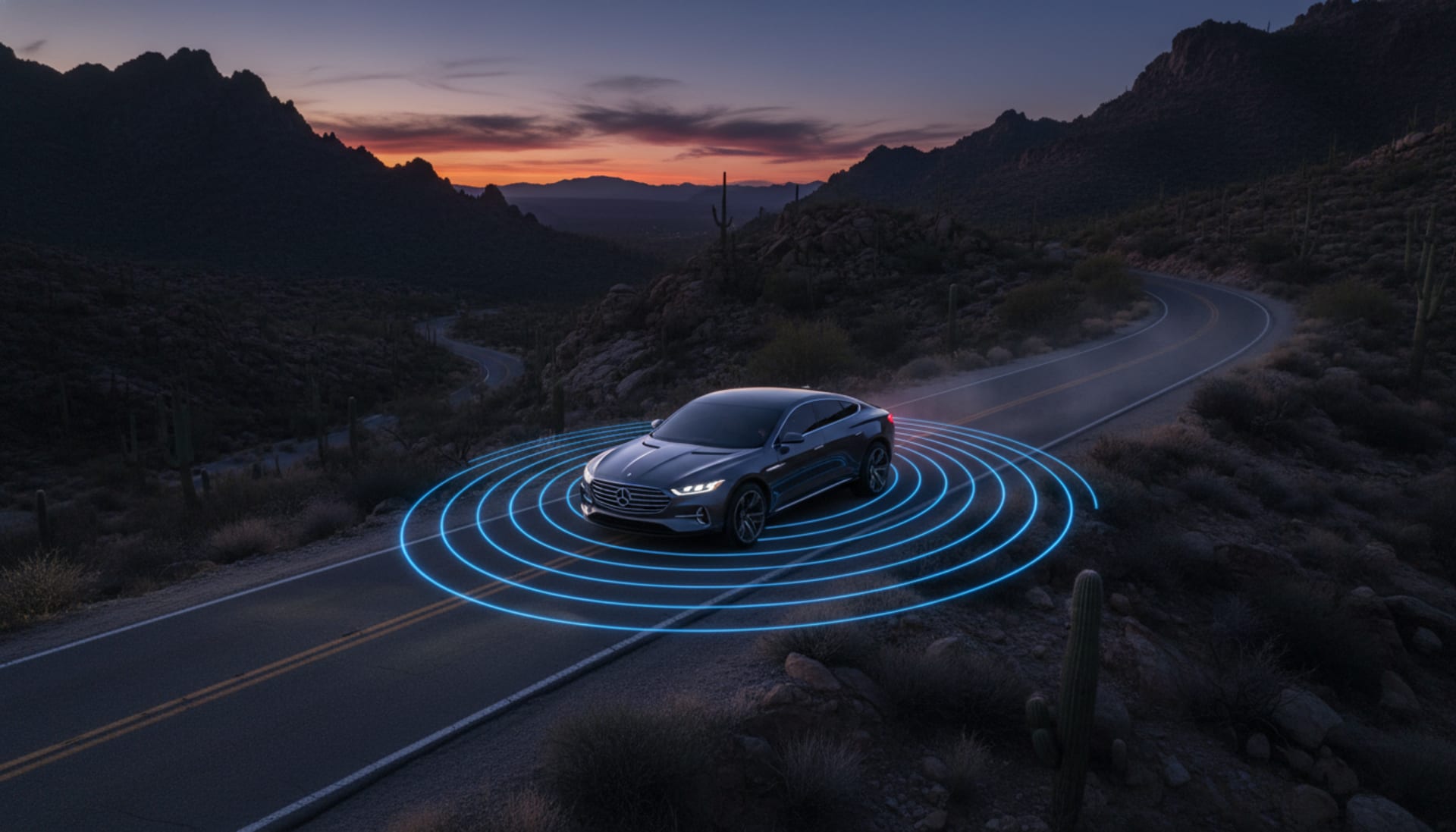
Mountain, Desert & Low-Connectivity Routes
The roads where safety technology is needed most are often the ones it reaches last. Magen Daniel Systems is building V2X solutions designed to work where standard connectivity doesn't.
Overview
Safety Without Borders — or Signal Bars
Mountain passes, desert highways, remote mining and forestry roads, and cross-country freight routes share one critical vulnerability: when something goes wrong, the infrastructure to respond is far away and connectivity to call for help may not exist.
Standard V2X systems depend on cellular network coverage to relay safety data. Magen Daniel Systems is developing a mesh-capable architecture where vehicles share safety intelligence directly with each other — without cellular infrastructure as an intermediary.
This means hazard awareness, vehicle proximity alerts, and emergency notifications can propagate across a convoy or a stretch of isolated road using only the vehicles themselves as network nodes.
Key Capabilities
Intelligence That Travels with the Vehicle
Mesh V2V Communication
Vehicle-to-vehicle mesh networking allows safety data to propagate across a convoy or stretch of road without any fixed infrastructure — functioning when cellular coverage is absent or intermittent.
GNSS/IMU Dead Reckoning
Advanced sensor fusion maintains accurate vehicle positioning even when satellite signal is blocked by terrain, tunnels, or deep canyons — critical for accurate hazard alerting on complex routes.
Terrain-Aware Hazard Alerts
Altitude, gradient, and road surface data inform advisory thresholds — ensuring alerts account for mountain-specific hazards like loose gravel, steep descent zones, and reduced-traction conditions.
Oncoming Vehicle Detection
On narrow mountain roads where opposing traffic is invisible around hairpin bends, V2V proximity exchanges alert both drivers before visual contact is possible — with enough time to react safely.
Emergency Incident Broadcasting
When an incident occurs in a remote area, V2V broadcast propagates an emergency flag to approaching vehicles — reducing secondary incident risk while help is en route.
Low-Power Deployment Mode
The hardware unit is being designed for efficient power operation, supporting extended remote deployments on vehicles without continuous external power access — relevant for off-grid operations.
Practical Scenarios
Where the Road Goes Further Than the Signal
Mountain Pass Road Freight
Heavy goods vehicles on high-altitude passes face oncoming traffic on narrow roads, extreme gradient braking demands, and near-zero cellular coverage. V2V mesh alerts protect both the truck and oncoming vehicles.
Remote Mining & Resource Operations
Mine sites and forestry operations involve large vehicle convoys on unmapped, unpaved routes with no cellular coverage. V2V mesh intelligence keeps the convoy connected and operators aware of vehicle positions and incidents in real time.
Desert Highway Long-Haul Routes
High-speed desert routes in low-population areas — where a breakdown or medical event may go undetected for hours. V2V-propagated incident flags allow nearby vehicles to notify emergency services on the affected vehicle's behalf.
Tourist & Adventure Travel Routes
Recreational drivers in mountain, jungle, or desert environments — often unfamiliar with the road — benefit from proximity alerts and hazard warnings that don't depend on signal coverage or local map knowledge.
Operating in Remote or Low-Signal Environments?
Tell us about your operational environment and route requirements. We'll evaluate how the Magen Daniel Systems mesh V2X platform can support safety in your specific context.